
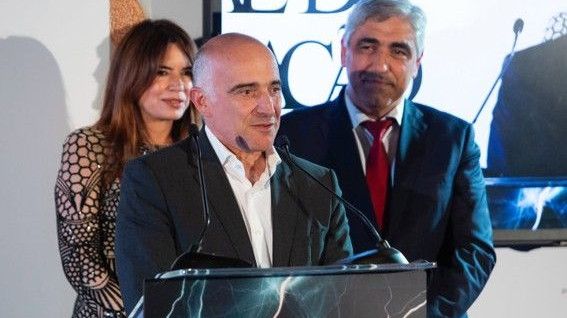
Contacto Atlântico was featured in The Portugal News, the widest-reaching English-language newspaper in Portugal, which reaches more than 400,000 people a week in several languages. In an opinion piece by Paulo Lopes, CEO of Casaiberia, the author celebrates the studio’s distinction at the DNA Paris Design Awards 2026, in the Refurbishment category, for its work on the Rossio Block in Lisbon, taking it as an example of Portuguese talent recognised across borders.
What are the DNA Paris Design Awards?
The DNA Paris Design Awards are one of the most prestigious international design competitions, based in Paris, honouring outstanding work across several disciplines, from architecture to interior design. Entries are assessed by an international jury of specialists, which makes every distinction a recognition by peers. Winning in the Refurbishment category places Contacto Atlântico among the studios shaping the future of heritage restoration worldwide.
Why is the Rossio Block such a special project?
The article highlights what makes this intervention unique. The Rossio Block is built on the restoration of a Pombaline building around two centuries old, in one of Lisbon’s most emblematic locations. Pombaline architecture is the planned reconstruction style of Lisbon’s Baixa district after the 1755 earthquake, marked by regularity and standardised building systems, and it is precisely this character the intervention sought to preserve.
As Paulo Lopes writes, the project “sought to recover and preserve historical elements, from the frescoes to the tiles and the façade itself, reconciling them with the requirements of a contemporary use”. It is this ability to balance memory and present-day use that the jury recognised.
A story of continuity between generations
One of the most striking points in the piece is its reading of Contacto Atlântico as a story of continuity. The author congratulates the founder, architect André Caiado, and gives special mention to his son, João Caiado, who “also represents the continuity of a professional history built over many years with passion, demand, creativity and, above all, hard work”.
For Paulo Lopes, there is something particularly beautiful about this relationship between generations: architecture is made of the transmission of experiences and principles, yet each new generation adds its own vision and energy. It is this relationship between past and future that, in his reading, makes the project so special.
What does it mean to restore heritage?
The piece clearly sums up the philosophy behind Contacto Atlântico’s work. Restoring heritage “does not simply mean conserving what already exists”, the author writes, but rather “understanding its history, respecting its identity and finding a clever way to bring it back to life”. He adds a sentence that captures this approach: “It is a way of making architecture that I deeply respect: the one that does not need to erase the past to build the future.”
Portuguese architecture that crosses borders
More than the distinction of a single studio, the article reads this award as a sign of the quality of Portuguese architecture. “When a Portuguese project is awarded in Paris, it is not only a studio that receives a distinction. It is also Portuguese architecture that crosses borders and demonstrates to the world the quality that exists in our country,” writes Paulo Lopes.
For Contacto Atlântico, a leading architecture studio in Portugal with more than 30 years dedicated to urban restoration in Lisbon, this international recognition reinforces a position built over decades: that of a benchmark in heritage restoration, in Portugal and beyond.
You can read the full article in The Portugal News here.
Discover the Rossio Block project and read more about the DNA Paris Design Awards distinction.