
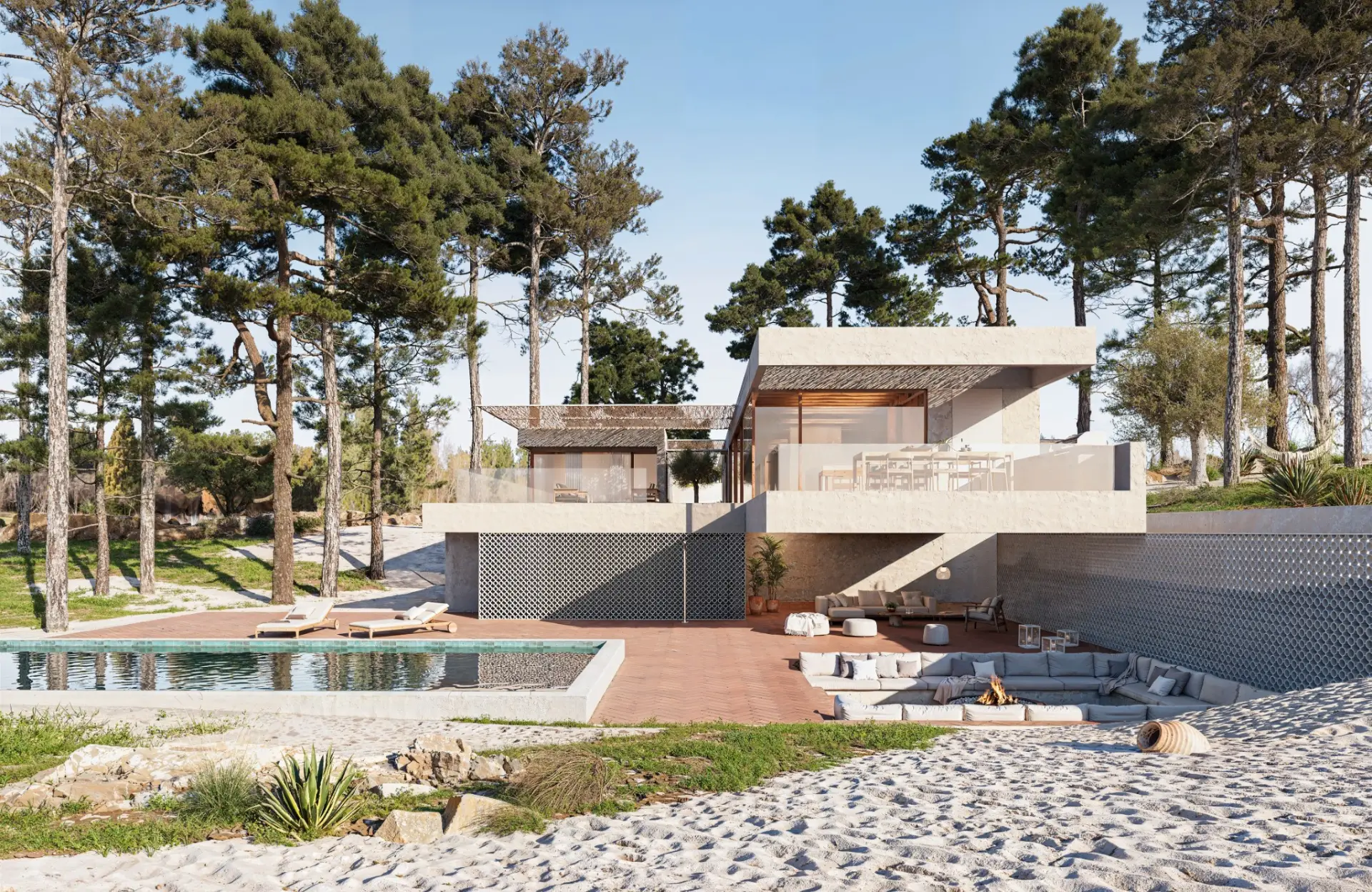
Villa Brisa is a private residence in Melides, designed by Portuguese architecture studio Contacto Atlântico. Located within the Costa Terra Golf & Ocean Club estate, this luxury villa in Melides spans a gross floor area of approximately 475 square metres and was conceived to settle quietly into the soft dune topography of Portugal’s Alentejo coast. The brief was clear: maximum privacy for the client, with no compromise to the surrounding landscape.
Where is Villa Brisa located?
Villa Brisa sits within Costa Terra Golf & Ocean Club, a coastal estate on the Alentejo coast in southwestern Portugal. Melides has emerged as one of the country’s most sought-after destinations for considered, low-impact residential architecture, valued for its dunes, cork oak forests, and protected coastal landscape.
How does the design respond to the dune landscape?
Rather than reshape the terrain, Contacto Atlântico broke the home into separate volumes and positioned each one to follow the natural rise and fall of the dunes. This fragmented approach allowed the studio to carve shaded outdoor areas between the volumes, encourage natural airflow through the interior spaces, and frame specific views of the surrounding landscape.
The result is a home that reads less as a single mass and more as a sequence of pavilions threaded carefully into the existing topography. Each volume earns its place by responding to a particular view, breeze, or pocket of shade.
What is a cobogó wall, and why does it matter here?
The most distinctive sustainable feature of Villa Brisa is its use of cobogó walls. A cobogó is a perforated screen, traditionally made from concrete or ceramic, that functions as a wall while still allowing air and filtered light to pass through. The element originated in Brazilian modernist architecture and has been widely adopted in warm-climate design across Portugal, Spain, and Latin America.
In Villa Brisa, the cobogó walls do two jobs at once. First, they let the house breathe on warmer days by drawing air through the interior, which reduces the need for mechanical cooling. Second, they filter direct sunlight into softer, patterned light, lowering heat gain on the building envelope without darkening the rooms.
Why is passive design important in luxury Portuguese architecture?
Passive design means using a building’s shape, orientation, and materials to stay comfortable without relying heavily on air conditioning or heating. In a coastal climate like Melides, where summers are hot and dry, passive strategies such as natural ventilation, shaded patios, and breathable wall systems can significantly cut energy use over the life of the home.
Villa Brisa brings this thinking into the luxury villa market in Portugal, where energy performance has historically been an afterthought. By making cobogó walls and dune-aware massing central to the design rather than decorative, Contacto Atlântico shows that high-end residential architecture and sustainability can sit comfortably together.
A home that reveals itself
Villa Brisa is a study in restraint. By placing each volume with care, layering cobogó screens through the building envelope, and designing for natural airflow, Contacto Atlântico has produced a sustainable villa in Portugal that does not impose itself on its setting. It reveals itself, with lightness and intention.