
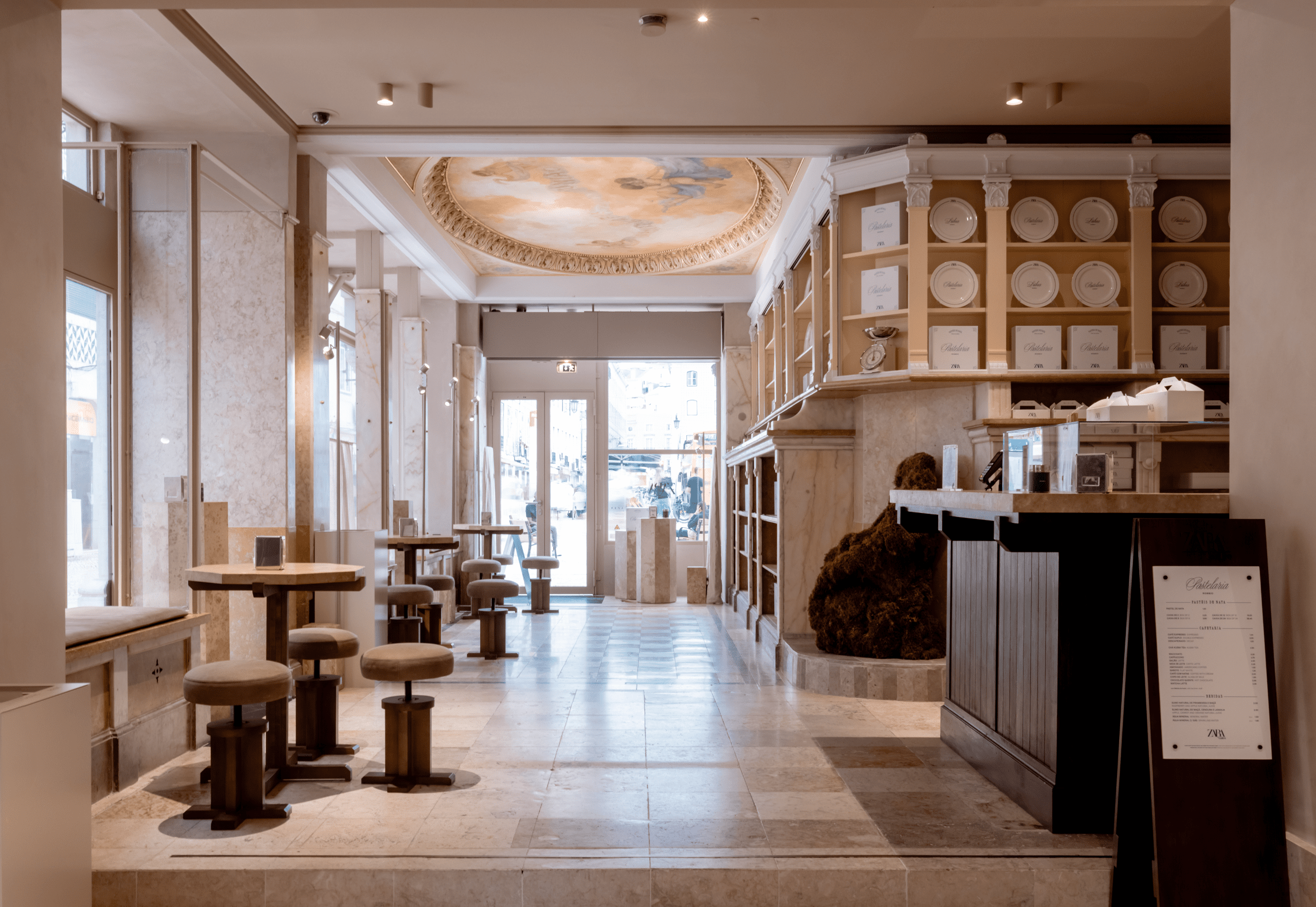
Zara’s new store in Lisbon occupies an entire city block in the most central square of the city. A building abandoned for decades, whose recovery has probably been the most emblematic in the Portuguese capital in recent years.
Anyone visiting Rossio Square, in Lisbon, is immediately drawn to two buildings: the National Theatre D. Maria II and the space now almost entirely occupied by an enormous Zara store. With a surface area of 5,000 square metres spread over four floors, it is almost as large as the one on Plaza de España in Madrid, with extensive areas dedicated to Women, Men, Kids and Zara Home collections, as well as specialised boutiques for Lingerie, Beauty, Footwear and Accessories, in addition to sportswear.
Occupying an entire city block, the store has two entrances: one facing Rossio and another facing Praça da Figueira, where Zara by Castro has opened — a café in collaboration with Atelier Castro that serves some of the best pastéis de nata in the city. It may not be the largest Zara in the world, but it is the only one where you can eat pastéis de nata. It is worth recalling that last November Zacaffé opened in the new Zara Man store in Madrid.
The interior design was carried out by a long-standing collaborator of the Inditex group, the studio of Elsa Urquijo, responsible for some of Zara’s most spectacular stores. However, the entire recovery of the building predates the arrival of the store and was carried out by Contacto Atlântico, the architectural practice led by architect André Caiado.
This studio has signed dozens of restorations in the Baixa Pombalina alone, as well as several luxury projects on Avenida da Liberdade, including the Prada, Armani, Max Mara and Miu Miu stores.
Lisbon residents call their downtown Baixa Pombalina, in honour of the Marquis of Pombal, who organised the reconstruction of the city after the 1755 earthquake, commissioning buildings with anti-seismic techniques (at least for the time) and planning a more modern and open urban layout.
“The renovation of the historic centre creates quality of life for residents, value for properties and an aesthetic and cultural environment that benefits everyone,” explains Caiado. “It is what we usually call a win-win situation: the city, residents, tourists and property values all benefit.”
The recovery of this particular city block took nearly five years and faced several challenges, as it is one of the key buildings from Lisbon’s reconstruction after the earthquake. Over the past 50 years, the upper floors were practically unoccupied, although the commercial spaces were not.
Throughout its nearly 250-year history, the building housed various businesses that shaped the city, including the famous Pastelaria Suíça, the preferred café of Lisbon society for almost a century; the Joyería Portugal; the Hotel Francfort; and Pérola do Rossio, a tea room and café opened in 1923 that, curiously, continues to operate in the renovated building. In fact, it is the only other tenant besides Zara.
The Investment by Mabel Capital
The building was acquired by the Spanish firm Mabel Capital in 2017. At the time, the company was managed by Abel Matutes Prats and Manuel Campos, with Rafael Nadal as the main investor. Through its subsidiary JCKL, Mabel paid around 62 million euros for the property and invested a further 17.5 million euros in its recovery, excluding interior finishes.
“The first logical decision was not to excavate or create basements, avoiding as much as possible any alteration to what lies beneath the ground,” explains André Caiado, referring to the site’s earlier occupations, from Roman times to the Hospital de Todos os Santos, which stood on the site before being destroyed by the 1755 earthquake and tsunami.
The reconstruction was carried out in accordance with the so-called Cartulário Pombalino, a set of original plans that allow identification of the elements that changed in the building and enable a return as close as possible to its original state, as explained by the architect — while, of course, “respecting the technological needs of our time”.
The studio also incorporated several elements from the building’s historical uses, such as the entrance door of the Hotel Francfort, the stair core and the elevator running through the entire building. The façades of Manteigaria União, from 1900, and Joyería Portugal, from the 1920s, were also preserved. “We found tiles from so many periods that we could almost document an evolutionary history of Portuguese tiles,” the architect notes, adding that “all tiles that were not reused were donated to the National Tile Museum”.
In the new space, many decorative ceiling and wall paintings are also visible, rehabilitated by the team and serving as a living testimony to this past.
Details that Elsa Urquijo’s studio knew how to make the most of: “The store’s decoration adapted magnificently to the building. The choice of materials, the preservation of the stone flooring on the ground floor, the wooden floors in some areas of the upper floors, not to mention the strategic views over the two squares and their integration into the Zara Home spaces,” praises the Portuguese architect. “Buildings are living entities that evolve over time. This one welcomes a new life with open arms — a ‘grand department store’.”
This new Zara concept, with different boutiques, is closer to the idea of a department store — albeit a single-brand one — than to a traditional shop. It has returned to fashion after years of crisis caused by online shopping, precisely because it offers differentiated customer experiences.
We are witnessing the resurgence of these spaces across Europe, especially in Paris, where the case of the LVMH group is paradigmatic. After investments in stores such as Samaritaine, the group is now preparing to open the world’s largest Louis Vuitton on the Champs-Élysées, complete with restaurant and even a hotel. In Lisbon, there is only a café serving pastéis de nata — but in a place full of memories and charm.