
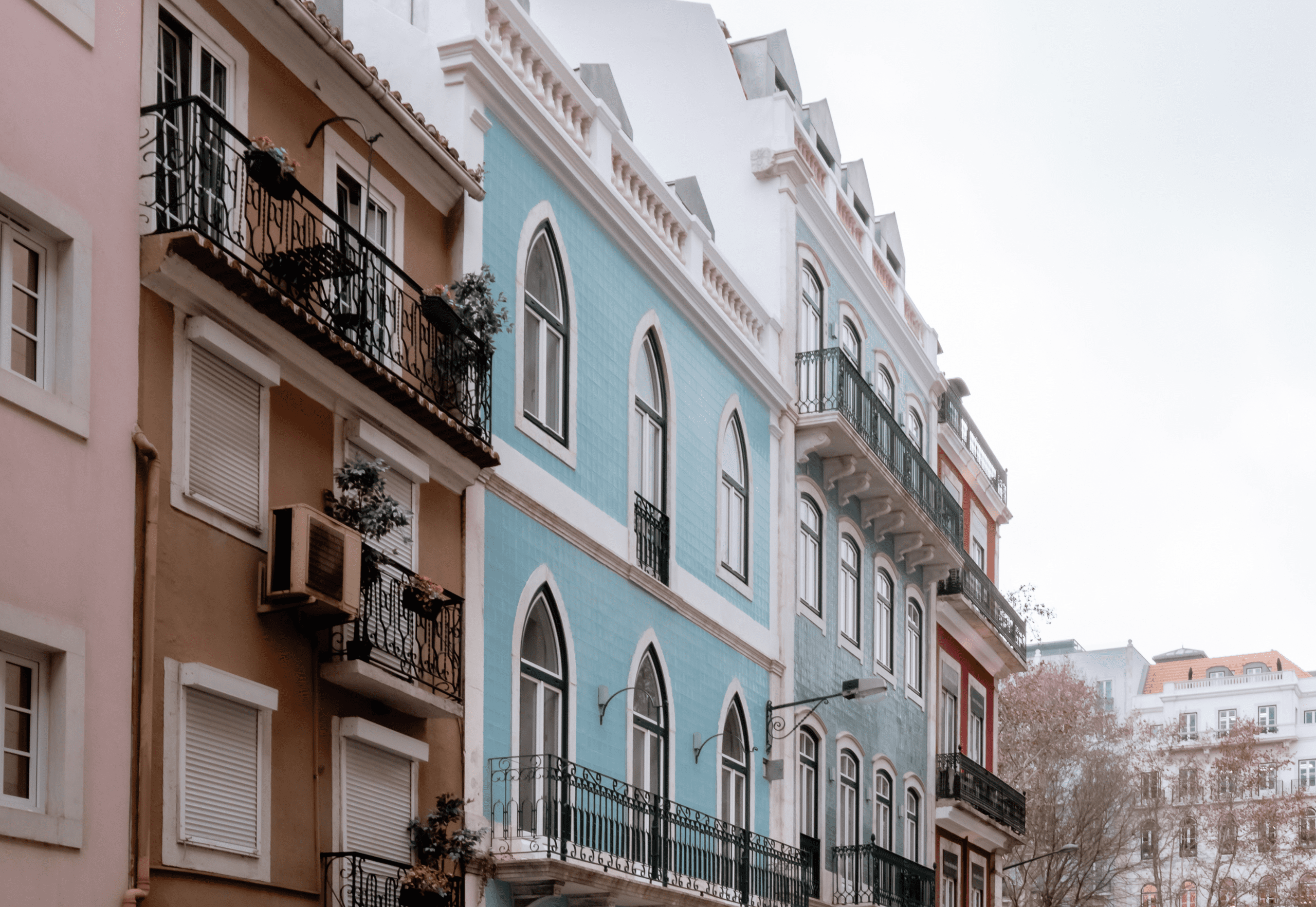
By Liberdade is one of the latest Contacto Atlântico projects in Lisbon, bringing two adjoining historic buildings on Rua das Pretas back into full use as homes and shops just steps from Avenida da Liberdade. The Lisbon architecture studio led the deep rehabilitation of numbers 33 to 37 and 41 to 47, joining them into a single residential and commercial address with new apartments above and a continuous shopfront below. The total construction area reaches 1,134.79 square metres on a footprint of 292.90 square metres.
What is By Liberdade and where is it located?
By Liberdade is a residential and commercial development located on Rua das Pretas, a side street that opens directly onto Avenida da Liberdade in central Lisbon. The project is signed by Contacto Atlântico, the Lisbon architecture studio led by founder André Caiado, and unites two historic buildings under one cohesive scheme: number 33 to 37, and number 41 to 47.
Construction area and footprint are two different measurements that often confuse buyers. Footprint is the area the building occupies on the ground (in this case 292.90 sqm), while construction area is the total floor area across every level (1,134.79 sqm). The difference tells you the building goes up several storeys on a relatively compact plot.
How many apartments does By Liberdade have?
The two buildings hold eight apartments in total, distributed by typology.
Number 33 to 37 contains two T1 apartments on the first floor and two T0 apartments on the third floor. In the Portuguese property market, T0 means a studio apartment with a single combined living and sleeping area, while T1 means a one-bedroom apartment with a separate bedroom in addition to the living space.
Number 41 to 47 holds four T3 apartments on the upper floors. T3 stands for a three-bedroom apartment, in this case with one unit per floor, which means each home occupies an entire level and has its own independent entrance.
What did the rehabilitation involve?
A deep rehabilitation goes well beyond a cosmetic refresh. It is a full functional and structural modernisation that brings an older property up to current building standards while keeping its original character intact. According to Contacto Atlântico, the intervention “fully respected the existing volumetry, providing for the functional and structural modernisation of the buildings for residential and commercial use, with the creation of skylights, modernisation of infrastructure, installation of elevators and replacement of construction elements that were in poor condition.”
Volumetry refers to the overall shape and massing of the building, including its height, depth and roofline. Respecting the existing volumetry means the new design did not raise the roof or push out the walls, which is what keeps the renovated buildings in dialogue with the rest of the historic street.
Which heritage elements did Contacto Atlântico preserve?
Several original features were kept and restored rather than replaced. The studio “sought to preserve the main architectural elements, with particular emphasis on the light-blue Viúva Lamego tile cladding on the 33 to 37 building, the redesign of openings and balconies.”
Viúva Lamego is a historic Lisbon ceramics manufacturer founded in 1849, known for its hand-painted azulejos. Preserving the light-blue tile cladding matters because these façades are a visible part of the city’s tile-making heritage, and replacing them with new materials would have erased one of the building’s strongest identity markers.
Beyond the tiles, the stone façades, stone masonry walls and the two stair cores were also maintained. Stair cores are the vertical spaces that contain the staircases and connect every floor of the building. Keeping the original stair cores preserves the spatial logic of the historic plan and avoids invasive structural work.
On the façades, the ground-floor openings were reinstated according to the historic layout, the doors at the extremities were restored, and the window frames and glazing were updated in line with current safety and durability standards.
How is the ground floor organised?
The ground floor was redesigned as a single, continuous commercial space spanning both buildings. The frontages were unified to improve the connection to the pavement and clarify the access points for pedestrians, while open-plan areas were prioritised inside.
This continuous shopfront does two things at once. It gives retailers a usable, flexible space rather than two narrow shops divided by a party wall, and it strengthens the relationship between the building and the street, which is what makes a façade feel alive rather than blank.
What changed inside the apartments?
The upper floors keep the original logic of one apartment per floor with independent entrances. Inside the apartments, “the intervention was limited to non-structural partitions in order to optimise circulation and use. Staircases and entrance halls were preserved due to their architectural value.”
Non-structural partitions are interior walls that do not carry the weight of the building above them. Working only with these walls allowed Contacto Atlântico to rearrange rooms and improve circulation without touching load-bearing elements, which keeps the heritage structure intact and shortens construction time.
To make the building fully accessible, a new elevator was added. The landscaped roof and the chosen materials, the studio notes, “enhance the quality and comfort of the spaces, while respecting the identity of the city’s urban fabric.”
What does André Caiado say about By Liberdade?
André Caiado, founder of Contacto Atlântico, frames By Liberdade as a contribution to the wider recovery of central Lisbon. “This is yet another project that Contacto Atlântico is proud to sign, contributing to the recovery of the city by restoring its beauty and historical identity. By Liberdade is another example of how urban rehabilitation can greatly benefit our capital,” he states.
His comment reflects the studio’s consistent position: existing buildings are not obstacles to development, but the raw material for it.
Why By Liberdade fits the Contacto Atlântico portfolio
By Liberdade brings together the threads that run through most Contacto Atlântico projects in Lisbon: deep rehabilitation rather than demolition, careful preservation of heritage elements such as Viúva Lamego tiles, stone masonry and original stair cores, and a clear effort to modernise infrastructure where it matters most, including elevators, skylights and new glazing. For anyone tracking the studio’s work, or for buyers and tenants looking at central Lisbon, By Liberdade is a useful example of how historic buildings near Avenida da Liberdade can be adapted to contemporary residential and commercial use without losing their identity.