
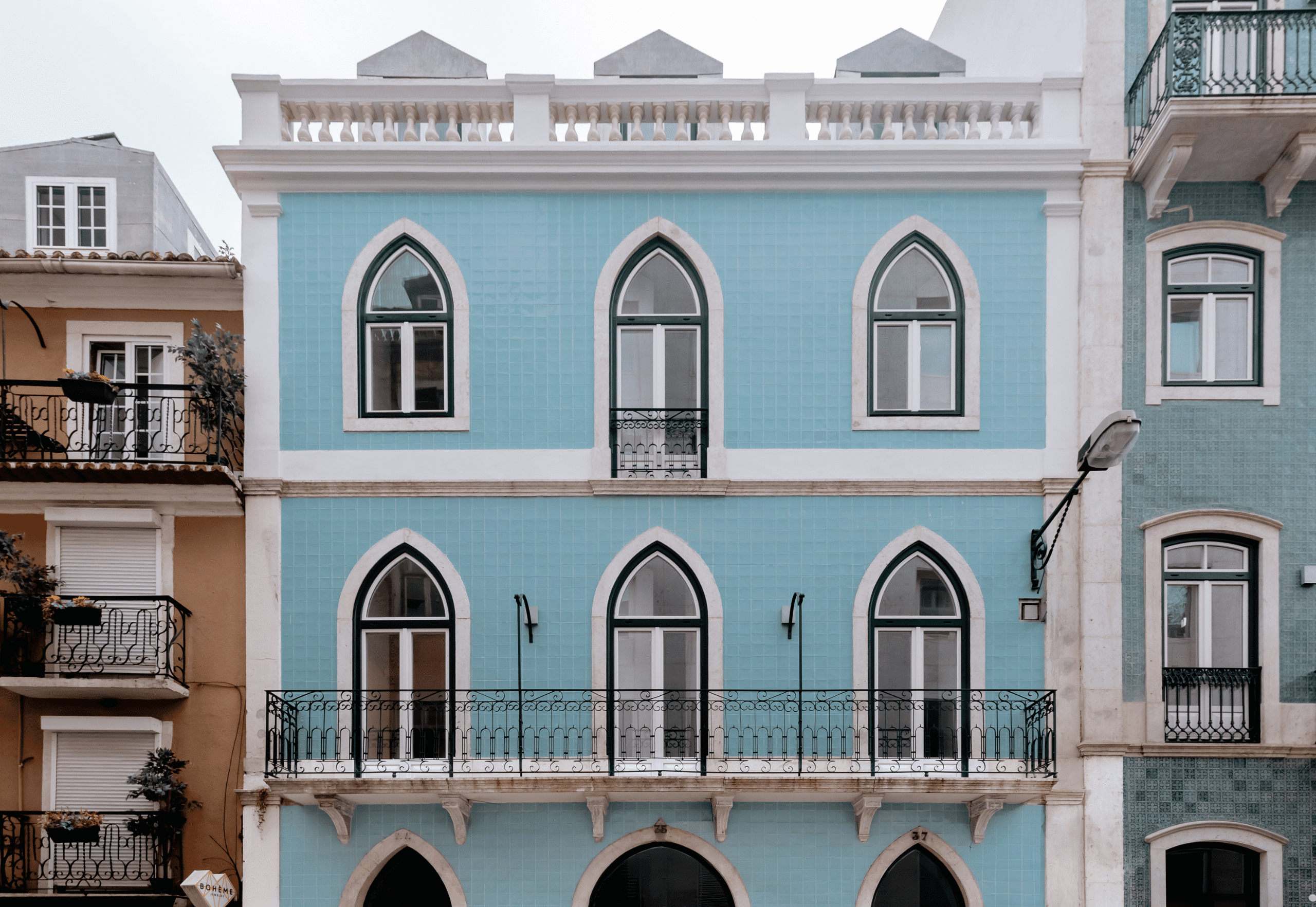
The Portuguese architecture studio unified two 19th-century buildings (nos. 33–37 and 41–47) into a single rehabilitated complex, preserving the original tile cladding, stone façades and stair cores while introducing modern infrastructure.
By Liberdade is an urban rehabilitation project located on Rua das Pretas, in the heart of Lisbon, designed by Contacto Atlântico, the Portuguese architecture studio founded by André Caiado. The intervention unifies two historic buildings, at numbers 33–37 and 41–47, into a single architectural complex with a total construction area of 1,134.79 square metres on a footprint of 292.90 square metres. The project’s central ambition is straightforward: recover the original character of these buildings while equipping them with the modern infrastructure that contemporary residential and commercial use demands.
Who is Contacto Atlântico?
Contacto Atlântico is a Portuguese architecture studio founded in 1996 by architect André Caiado, with headquarters in Estoril and close to 30 years of activity. The practice is known for projects that cross scales and typologies: the rehabilitation of the Quarteirão do Rossio in Lisbon (today home to the world’s second-largest Zara store), high-end residential projects in Cascais, retail design such as Nestlé The Good Store, contemporary residential landmarks like LINEA, and the wellness sector through Bio Ritmo São Paulo. By Liberdade adds another urban rehabilitation reference to that portfolio.
What is the By Liberdade project?
By Liberdade is the rehabilitation and unification of two adjoining historic buildings on Rua das Pretas, a street that runs into the wider Avenida da Liberdade area of central Lisbon, hence the project’s name. The intervention expanded and altered the two buildings to read as a single architectural complex, while keeping each building’s heritage identity intact. Across approximately 1,135 m² of construction area, the project combines preserved historic fabric with modern residential and commercial use.
What was preserved, and why?
Rehabilitation is the architectural discipline of restoring and adapting an existing building so it can continue to be used, rather than demolishing and rebuilding. A good rehabilitation decides carefully what to keep, what to replace and what to add. At By Liberdade, the preserved elements include:
- The original volumetry, meaning the overall shape and mass of the buildings.
- The light-blue Viúva Lamego tile cladding on the 33–37 building. Viúva Lamego is a historic Portuguese tile manufacturer founded in 1849 and considered one of the most important producers of decorative ceramics in the country, so preserving this cladding protects a piece of Lisbon’s material heritage.
- The redesigned openings and balconies, the stone façades, the stone masonry walls, and the two stair cores (the vertical circulation elements that contain the staircases).
This is what allows the buildings to keep their visual identity as part of historic Lisbon, instead of being flattened into a generic refurbishment.
What was added or modernised?
To make the buildings fit for contemporary use, Contacto Atlântico introduced several upgrades while respecting the original architecture:
- Skylights were opened to bring natural daylight deeper into the interior, particularly important in 19th-century buildings that typically suffer from limited light at the centre of the floorplate.
- An elevator was installed to ensure accessibility, addressing one of the main functional limits of historic Lisbon buildings, which often only have stairs.
- Construction elements in poor condition were replaced, the infrastructure (electrical, hydraulic, communications) was fully modernised, and window frames and glazing were updated to meet current safety and durability standards.
- The ground-floor openings were reinstated in accordance with the historic layout, restoring the proportion of the original façades.
How is the building organised inside?
By Liberdade is structured to do two things at once: a commercial ground floor that opens onto the street, and independent residential apartments above.
Ground floor
The two street fronts now form a continuous commercial space, after upgrades to the connection with the pavement and the entrance points. The design prioritises open-plan areas, the architectural term for large, mostly unbroken floor space with few internal walls, which is what most contemporary retail and office tenants expect.
Upper floors
Above ground, the buildings keep their original residential character: independent entrances from the street, and one dwelling per floor. Inside, only the non-structural partitions, meaning interior walls that do not carry load, were rehabilitated. The staircases and entrance halls were preserved, and the new elevator was added to bring the buildings up to contemporary accessibility standards without altering the historic circulation.
Why does this kind of urban rehabilitation matter for Lisbon?
For Lisbon, urban rehabilitation is not just a real estate strategy. It is the main way the city’s historic neighbourhoods stay alive without losing their identity. Many central Lisbon buildings sit empty or in poor condition because their original infrastructure cannot support modern use. A well-executed rehabilitation, like By Liberdade, brings these buildings back into the city’s daily life while preserving the visible elements (tiles, stonework, façade proportions, stair cores) that make historic Lisbon recognisable.
In a statement, André Caiado, founder of Contacto Atlântico in 1996, highlights the company’s “pride” in signing this project, “contributing to the recovery of the city by restoring its beauty and historical identity”, referring to By Liberdade as “yet another example of how urban rehabilitation can greatly benefit our capital”.
Where does By Liberdade sit within Contacto Atlântico’s portfolio?
By Liberdade reinforces a clear specialism in Contacto Atlântico’s portfolio: complex urban rehabilitation in central Lisbon. It sits alongside the studio’s work on the Quarteirão do Rossio, which today houses the world’s second-largest Zara store, and forms part of the same architectural argument: that careful, contextual intervention can return historic buildings to active use without erasing them. Combined with the studio’s high-end residential work in Cascais, its retail design for Nestlé and its first international project for Bio Ritmo São Paulo, By Liberdade confirms the breadth of the practice and its position within luxury Portuguese architecture.