
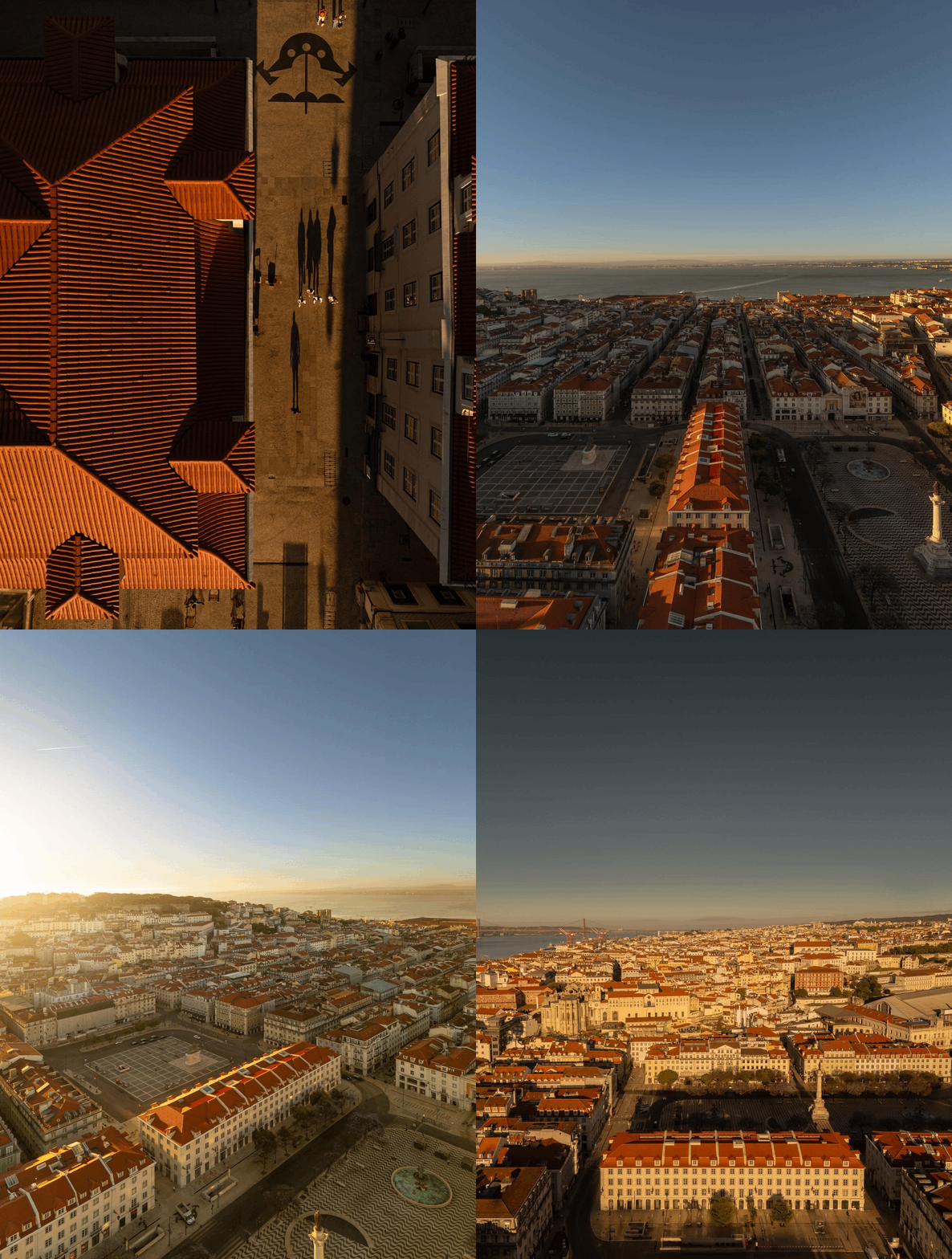
A thank you to the photographer who eternalised our most iconic Lisbon project, and a note on why light matters so much to how we design.
At Contacto Atlântico, we believe Lisbon gives us light, and that architecture exists to shape it. Photography, in turn, is what preserves that conversation between light, matter and city. This is why we want to publicly thank Fernando Guerra for the work he produced on our Quarteirão do Rossio, the rehabilitation project at the heart of the Portuguese capital that we have been building for the city.
Rossio has never been just a place. With this intervention, it is now a block that opens to the city, made of shadow, colour, clarity and matter.
Who is Contacto Atlântico?
Contacto Atlântico is a Portuguese architecture studio founded by architect André Caiado, with close to 30 years of activity and headquarters in Estoril. Our portfolio crosses scales: large-scale urban rehabilitation such as the Quarteirão do Rossio, high-end residential homes in Cascais, retail design like Nestlé The Good Store, and contemporary residential projects such as LINEA in central Lisbon.
What is the Quarteirão do Rossio?
The Quarteirão do Rossio is one of central Lisbon’s most emblematic city blocks, in the heart of the city’s historic centre. We led its rehabilitation, and the block now houses, among other tenants, the world’s second-largest Zara store. The project balances heritage preservation with contemporary use, taking what had become a closed-in urban block and opening it back to the city.
Why does light matter so much to this project?
Lisbon is a city defined by its light. The hilly topography, the proximity to the Tagus and the Atlantic, and the consistently clear skies produce a quality of daylight that has shaped Lisbon architecture for centuries: bright on stone, sometimes hard at noon, deeply atmospheric at dawn and dusk.
For us, designing in Lisbon means designing with that light in mind. In the Quarteirão do Rossio, this meant opening the interior of the block, modulating shadow and material, and choosing surfaces that respond to changing daylight rather than fight it. The architecture is, in this sense, an instrument that shapes how Lisbon’s light enters the city.
Who is Fernando Guerra?
Fernando Guerra is a Portuguese architectural photographer of international reputation, widely regarded as one of the most influential figures in the field. His work is regularly published in global architecture media and has helped define how contemporary Portuguese architecture is read internationally. Architectural photography, for context, is the discipline of photographing buildings and spaces in a way that explains how the architecture functions, not only how it looks.
What did Fernando Guerra capture in the Rossio Block?
Architectural photography is not a passive record of a building. Done well, it interprets how a space works, how it is used, and how it sits in time. In his images of the Quarteirão do Rossio, Fernando Guerra brought together the four elements that defined the project for us: the shadows that fall across the rehabilitated façades, the colours of the surrounding city, the clarity of the new circulations through the block, and the material weight of historic stone meeting contemporary intervention.
His photographs preserve the project as it exists in real Lisbon conditions, with the city moving around it.
Why does this collaboration matter to us?
A built project lives twice: once as a physical space used every day, and once through the images that travel with it. The first life depends on us as architects. The second depends on a photographer who can read the building well. Working with Fernando Guerra on the Quarteirão do Rossio means our project enters the international architectural conversation with the care and precision it deserves.
For us at Contacto Atlântico, this is part of how a piece of luxury Portuguese architecture moves from a local intervention to a lasting cultural reference.